Boost.space AgentOS review: this AppSumo deal is aimed at connecting AI agents to business data and apps, with permissions, reusable skills and automation capacity. The licence is only one part of the cost. Model usage, wallet spending and the way automation operations are counted matter just as much.
My verdict is to pilot a small internal role with clear inputs and an easily checked result. A daily summary or a limited data-maintenance task is a more useful starting point than asking an agent to run the whole business. I have not independently tested AgentOS, its integrations or its savings reports.
Check the live Boost.space AgentOS AppSumo offer →
Watch the Boost.space AgentOS AppSumo demonstration
What is Boost.space AgentOS?
AgentOS is a workspace for agents, connected apps and shared business data. The current listing describes isolated environments, permissions, skills and ACT automations. Its useful promise is giving an assistant a defined operating context rather than repeatedly pasting information into an unrelated chat.
A business role still needs a clear responsibility. “Monitor stock and prepare a reorder suggestion” is easier to assess than “manage e-commerce.” Define what the agent can read, what result it should produce and which decisions require a person.
AgentOS AppSumo pricing and allowances
The first four tiers showed these prices on 23 November 2026 during the current promotional offer. The live price may change after the time-limited promotion.
| Tier | Price checked | Agents | Environments | ACT operations / month | Records | Seats |
|---|---|---|---|---|---|---|
| 1 | $75.65 | 3 | 1 | 10,000 | 10,000 | 1 |
| 2 | $160.65 | 8 | 1 | 20,000 | 25,000 | 3 |
| 3 | $305.15 | 20 | 2 | 50,000 | 75,000 | 10 |
| 4 | $517.65 | 40 | 5 | 100,000 | 200,000 | 25 |
Do not treat those allowances as interchangeable. More agents do not automatically mean more records, free model use or unlimited execution. Choose the tier around the actual people, data and workloads involved.
ACT operations are based on runtime
The official FAQ says one ACT operation covers up to five seconds of automation runtime, with each started block counted and waiting included. Its example is an eleven-second run using three operations. Test runs count too.
This is a different unit from a simple count of business events. A process that waits for another service can consume more runtime than a short sequence that completes immediately. Estimate using representative runs rather than assuming one client request equals one operation.
Track retries and tests while designing the workflow. A large nominal allowance can still be used inefficiently by a process that polls unnecessarily or repeatedly handles the same record.
The AI wallet is a separate budget
The checked listing includes one dollar of monthly wallet credit. That is a trial-sized amount, not an unlimited AI budget. The official FAQ describes paying for models and other capabilities through the wallet or using your own eligible AI account.
The billing guide explains balance visibility, renewal and additional monthly credits. Check the actual model and service charges for your intended work before connecting a high-volume process.
For planning, record three figures separately: platform capacity, wallet spending and any direct provider bill. A prepaid licence can reduce a software subscription while leaving meaningful ongoing usage costs.
Permissions should follow the job
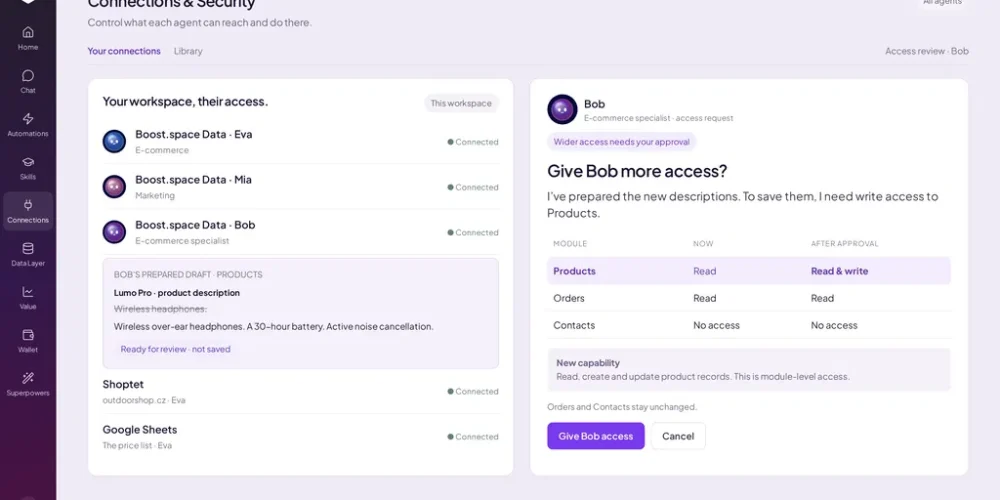
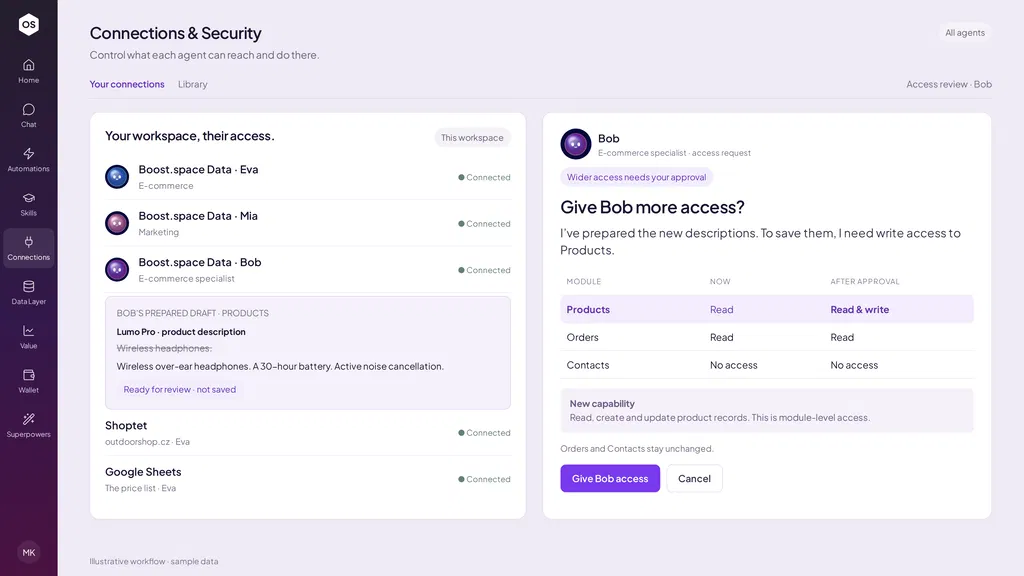
The official product guide distinguishes data permissions, connected apps and the people who can message an agent. It describes read and read/write access choices by module.
Start with the information needed for the role. An agent preparing a summary may not need permission to change customer records. If a later task needs write access, test that specific change and how it is recorded rather than granting broad access at the start.
Use a sample dataset where possible. Check that the agent finds the correct records and preserves the important qualifications. A confident explanation is not proof that it used the intended source.
Reusable skills need clear acceptance criteria
A skill should explain the result and the rules for reaching it. For a morning brief, specify which records matter, the time window and what counts as an exception. Otherwise each run may produce a different-looking summary without being more useful.
Keep the first version small enough to inspect. Ask the team member who normally does the task to compare the output with the manual result. Record missing context, incorrect assumptions and the corrections needed.
When a skill changes, retest the same examples. Reuse is valuable when it preserves a reliable process; it can also repeat an unnoticed error across several agents if nobody checks the underlying instructions.
Business data needs maintenance
Agents depend on the quality of the records they can access. Decide which system is authoritative for customer details, prices and status. Two connected apps can contain conflicting values, and an assistant needs a rule for choosing between them.
Define how updates move between systems and how duplicates are handled. Keep the source and last-change context visible. An automation that saves data in more places can create more reconciliation work if ownership is unclear.
For contact enrichment, my LeadOcean review covers a separate data service. Validate the relevance and currentness of any external information before treating it as operational truth.
Value metrics are estimates to review
A report showing hours saved needs a credible baseline. Decide how long the manual task actually takes and include review, corrections and maintenance in the comparison. Multiplying every run by an optimistic time estimate can overstate the benefit.
Measure completed useful work. A hundred automated runs that nobody uses are not equivalent to a hundred successful business outcomes. Keep a short record of errors caught and manual intervention required during the pilot.
Use the report to decide which workflows deserve more investment. The goal is a dependable process that helps the team, not simply more agents or a larger savings number.
AgentOS versus browser automation
My ZeroWork review covers a browser-based TaskBot approach. AgentOS is more focused on agents, connected business context and automation capacity. Compare the route that fits the source system and the work you need completed.
For coordinating the people around that work, my Nifty review examines a project workspace. An agent does not remove the need for an accountable owner and an escalation path.
Does the lifetime licence include unlimited AI?
No. The included wallet credit and external provider spending are separate from platform access.
Should I buy for self-hosting promises?
Verify current availability and the exact tier. The official FAQ marks some higher-tier capabilities as coming soon.
My AgentOS verdict
AgentOS could suit a defined internal role with useful connected data and clear permissions. Pilot the work, measure real usage and buy capacity around demonstrated needs rather than the largest agent count.
See Boost.space AgentOS pricing, limits and current availability →
Sources: current AppSumo listing and deal terms and the official sources linked in this review. Prices in USD, checked 23 November 2026; verify the live checkout total.