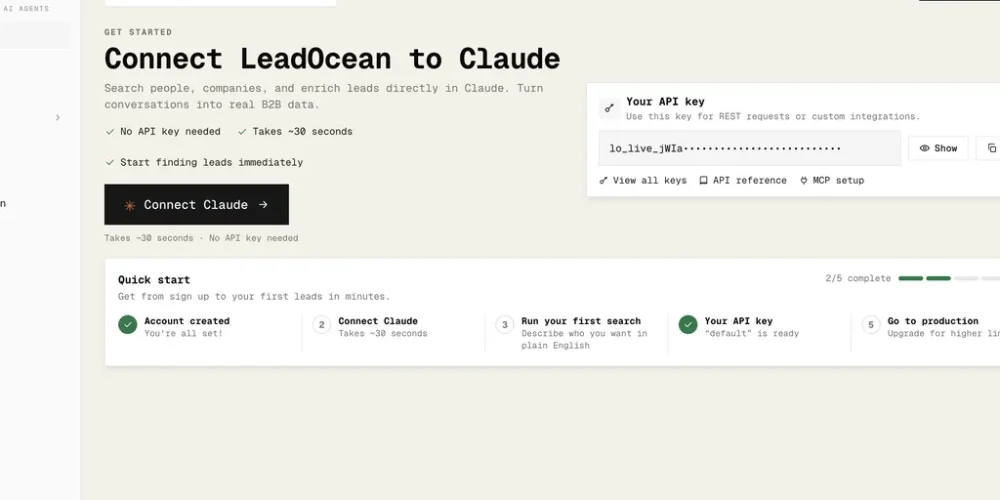
LeadOcean review: this AppSumo offer is most interesting for people who already know how they will use B2B contact data. It provides search and enrichment through an app, API and hosted MCP connection. It does not turn a broad list of contacts into a qualified sales opportunity by itself.
My verdict is to consider the entry tier for a defined research or enrichment workflow, then test coverage in your actual market. The headline database size is less important than finding the right people at the right companies with information you can validate. Pay particular attention to the rate and export limits behind the “no credits” positioning.
Check the live LeadOcean AppSumo offer →
What is LeadOcean?
LeadOcean is a people and company data service. The current vendor listing describes a corpus of 996 million people profiles and 73 million companies, with filters and enrichment intended for sales research. Those are vendor coverage figures, not a guarantee that every record is current or has a usable email address.
A useful application is filling gaps in an existing business record. You might know a company’s name and website but need to confirm its size, sector and the relevant department. That is a different job from sending messages, running an email sequence or managing an opportunity pipeline. Map the data step separately from the rest of your sales system.
LeadOcean AppSumo pricing and limits
The first four licence levels showed these prices and allowances on 23 November 2026. There is also a fifth tier; check the complete live table if your needs exceed the levels below.
| Tier | Price | Search records / week | Enrichments / week | CSV rows / day |
|---|---|---|---|---|
| 1 | $44.10 | 100,000 | 10,000 | 5,000 |
| 2 | $179.10 | 250,000 | 25,000 | 10,000 |
| 3 | $359.10 | 500,000 | 50,000 | 25,000 |
| 4 | $899.10 | 750,000 | 100,000 | 50,000 |
Shorter five-hour limits also apply. Tier 1 lists twenty thousand search records and two thousand enrichments in five hours, plus five API requests per second and one key. A large weekly allowance should not be read as permission to export everything in a single burst.
No credits does not mean no operational limits
The official API reference explains how returned records are counted. A search returning twenty-five people uses twenty-five records, while an enrichment counts even when it does not find a result. It also distinguishes permissions errors from empty results.
For planning, count the records your process touches rather than the number of buttons you click. A workflow that repeatedly requests the same search can consume capacity without improving the list. Keep a record of completed work, avoid duplicate enrichment and make failures visible so someone can decide whether a retry is useful.
The CSV limit may be the constraint for a largely manual workflow, while request speed may matter more for a live application. Write down both your normal daily workload and your largest batch. Buy for those requirements rather than treating the highest available tier as inherently better value.
A data-quality test worth running
Choose a representative sample before importing a large list. Include the countries, company sizes and job functions you actually target. A tool that works well for large US technology companies may perform differently for a specialist regional market. A random handful of well-known executives is a weak test of a niche prospecting requirement.
Review identity, current role, company association and contact availability separately. A record can match the person while still having an outdated title. A work email can appear plausible while belonging to a previous employer. Record what you checked and distinguish missing information from incorrect information.
Use a simple scorecard: correct person, correct organisation, relevant role, useful contact point and enough evidence to proceed. Calculate the share of usable records in your sample rather than reporting only how many rows the system returned. I have not independently measured LeadOcean’s coverage or deliverability, so this review does not assign an accuracy percentage.
Search filters should follow your buying criteria
Start with the companies most likely to benefit from your offer. Define sector, geography, business size and a reason the problem matters now. Then identify the role likely to own the problem. A large list based on a broad title can create more checking work than a smaller list built around a clear business need.
For example, an agency selling support to multi-location service businesses needs more than a generic “marketing manager” search. It may need to distinguish independent branches from centrally managed groups and confirm whether purchasing decisions are local. Write those questions down before assuming a title filter captures the intended audience.
Save the criteria alongside the export. When someone revisits the list later, they should know why those records were selected and what remains unverified. This makes research easier to update and helps prevent an old spreadsheet from becoming an unquestioned source of truth.
API and MCP: useful for repeatable work
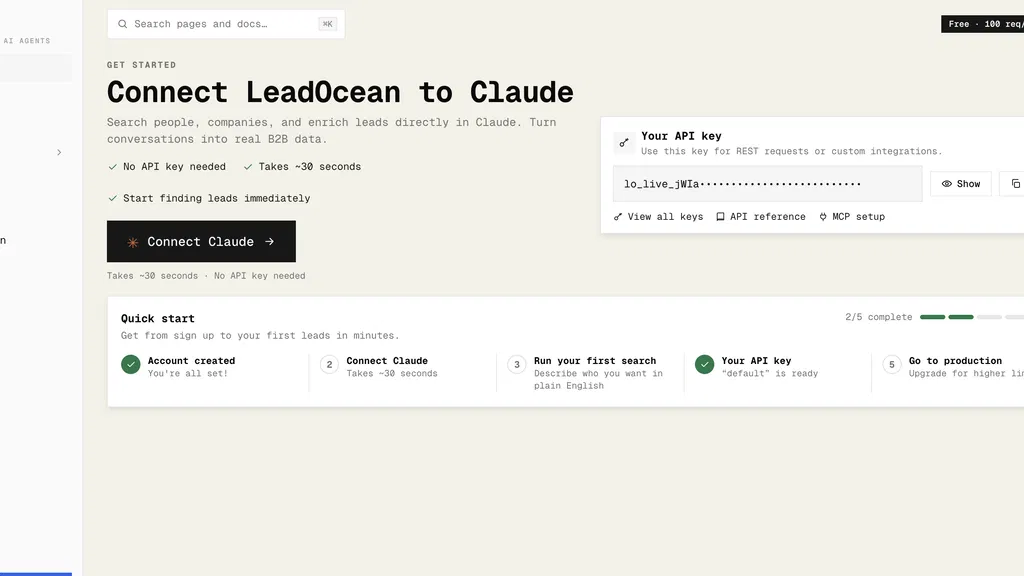
An API suits a process where data moves between systems repeatedly. MCP can make the same research accessible through a compatible assistant using natural-language instructions. The benefit is reducing repeated manual lookups, provided the resulting records remain inspectable and the task is clearly bounded.
Ask an assistant to explain its filters before exporting. “Find good leads” is too vague; specify the geography, role, company characteristics and maximum result count. Review a small result set before expanding. An assistant can make a request quickly while still misunderstanding what you meant by a qualified prospect.
For production use, establish who owns the integration, how failed requests are handled and where the source information is recorded. A working demonstration is not the same as a reliable daily process. Confirm the current capabilities in the official reference before building around an endpoint or field.
Where it fits in a sales workflow
LeadOcean supplies research inputs. Your team still needs an offer, a contact strategy, a way to record responses and a responsible owner for follow-up. Avoid buying overlapping tools simply because each one describes itself as a lead-generation platform.
For inbound enquiries, you might enrich a submitted business record to help a person prepare for a conversation. My Leadpages review covers building the page that collects the enquiry. If you want to assess automated responses after someone contacts the business, my DM Champ review examines inbox automation and its separate usage costs.
Keep research decisions and client delivery organised. A short note explaining why a company fits the campaign is more useful than a spreadsheet containing thousands of unexplained names. My Nifty review looks at a workspace option for shared tasks and approvals.
Alternatives: compare usable records
The listing names Apollo, Lusha and ZoomInfo as alternatives. Compare them using the same sample and the features your workflow needs. A data-only service should not be compared solely on price with a package that also supplies engagement tools you use every day.
Include the time spent checking and correcting results in your calculation. A cheaper export can become expensive if it creates hours of manual cleanup. Equally, paying for a broad platform may be unnecessary if all you need is a narrow enrichment step in an existing system.
Frequently asked questions
Is LeadOcean unlimited?
The offer uses no-credit positioning, but the live plan table specifies search, enrichment, export and API limits. Use those limits when deciding whether the licence fits your workload.
Does a database record guarantee a sales lead?
No. Relevance, current information and a reason for the business to engage still need checking. A record is a research input.
Who should consider the deal?
A founder, agency or technical team with a defined B2B research process and the capacity to validate data. I would be cautious if the purchase is driven mainly by the size of the database.
My LeadOcean verdict
The entry price can be appealing for a repeatable search or enrichment task. Test your own market, understand the overlapping limits and compare the number of useful records produced. That gives you a much stronger buying decision than the total number of profiles advertised.
See LeadOcean pricing, limits and current availability →
Sources: current AppSumo listing and deal terms and the official sources linked in this review. Prices in USD, checked 23 November 2026; verify the live checkout total.