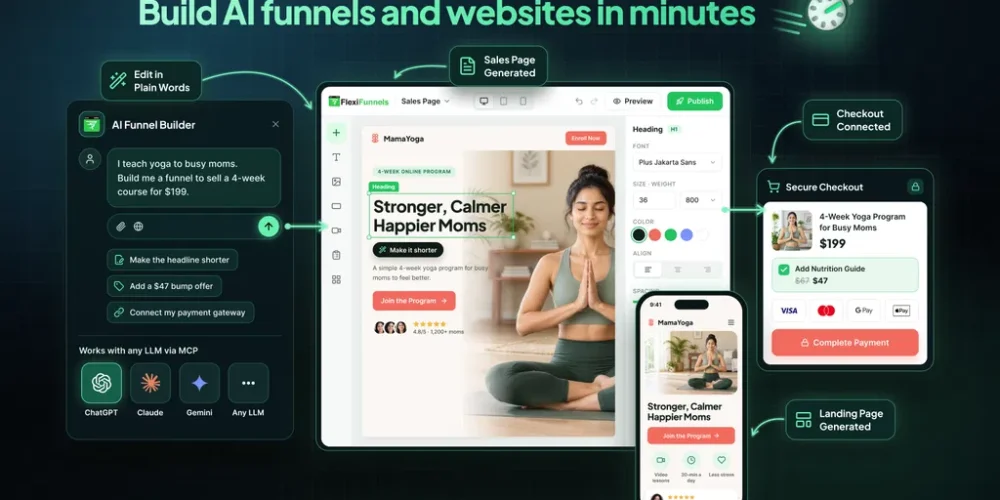
FlexiFunnels review: the AppSumo Black Friday deal looks attractive if you want landing pages, checkout and course delivery in one place. The important question is whether its limits fit your business. A low one-time price can be useful, but visitor caps, transaction fees and AI allowances still affect what you can build and what it costs to sell.
My verdict is to consider it for a focused new project, then validate the complete customer journey before moving an established business. I would not choose a higher tier simply because the feature list is long. Below, I explain the plan differences, the fee maths and the checks that matter most.
Check the current FlexiFunnels AppSumo offer →
What is FlexiFunnels?
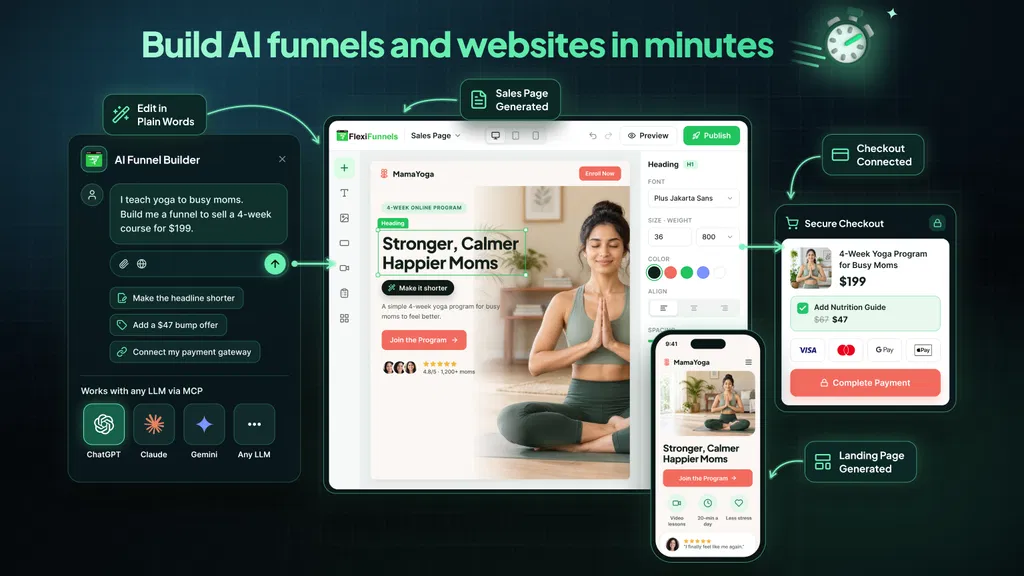
FlexiFunnels is a hosted platform for building funnels and selling digital offers. Its official site describes page editing, checkout, course delivery, communities and affiliate management. The AI workflow lets you describe a project conversationally, while manual editing provides a way to refine the result. Those capabilities make it interesting for course creators, coaches and small teams who want fewer disconnected systems.
Think about a short paid workshop. You need a page explaining the outcome, a payment step, confirmation and somewhere to deliver the content. Keeping those steps together can reduce the number of handoffs you manage. It does not remove the need for clear positioning, useful lessons or effective follow-up. Software can assemble the route; you still need a reason for someone to take it.
Watch the AppSumo product demonstration
This is the product video embedded on the FlexiFunnels AppSumo listing. It provides a visual introduction; the plan table and written terms determine what your purchase includes.
FlexiFunnels AppSumo pricing and plan limits
The live Black Friday listing showed these first four tiers. There were eight plans in total. Prices and availability can change, so compare the checkout screen with the allowance you need.
| Plan | Price checked | Domains | Monthly visits | Transaction fee |
|---|---|---|---|---|
| Tier 1 | $44.10 | 1 | 2,500 | 2% |
| Tier 2 | $116.10 | 3 | 5,000 | 2% |
| Tier 3 | $224.10 | 6 | 10,000 | 1.5% |
| Tier 4 | $449.10 | 10 | 15,000 | 1.5% |
Tier 1 also listed two courses, 1,000 course members and no sub-users. Its AI allowances were 100 monthly MCP credits and 100 one-time Genie chat-builder credits. These are separate buckets. The offer is for brand-new users, excluding previous accounts and trials, with activation required within 60 days. Future-update wording specifically names Basic/Core Website and Funnel Builder features.
I would choose the smallest tier that covers the project and a realistic growth margin. A solo experiment and a client agency have very different needs. If you need a collaborator to work inside the account, establish the user permissions you require before choosing a plan with no additional users.
The hidden-cost calculation: transaction fees
A platform fee is a recurring cost even when access is purchased once. At a hypothetical $5,000 in sales, a 2% fee represents $100; a 1.5% fee represents $75. That is a $25 difference for that sales period. This arithmetic does not include payment-processor charges, taxes, refunds or any other service costs.
Using the checked prices, Tier 3 costs $180 more than Tier 1. A half-percentage-point fee saving alone would offset that difference at $36,000 in cumulative fee-bearing sales. This is an illustration, not a forecast: verify what transactions the fee applies to and how it is collected before using it in your business budget.
The larger tier may be worthwhile sooner because you need its capacity. Equally, buying it only to save a fee can make little sense if you have not validated the offer. Work out the expected running costs and the actual plan constraints together.
How useful is the AI builder?
The most useful role for an AI builder is creating a first structure that you can inspect. Give it your audience, offer, pricing, desired action and brand constraints. Then review the output as if someone else had built the page for you. Check whether the headline explains the result, whether the evidence is real and whether the next step is obvious.
The official AppSumo FAQ describes both supplying your own copy and making manual edits after generation. That flexibility matters. A sensible workflow is to prepare the offer and proof first, generate a draft, then correct details and refine the layout yourself. Do not let generated testimonials, invented numbers or unsupported promises reach the live page.
Credit descriptions can differ between documentation for older AI tools and the current Genie/MCP offer. I would ask support which allowance a particular action uses and what happens when it runs out. Do not assume that a monthly allowance covers every AI feature or that a one-time allowance renews.
Payments, domains and course delivery need testing
FlexiFunnels’ payment and domain documentation explains adding gateway integrations, verifying DNS and configuring a separate sending domain. A chat interface does not eliminate those external setup steps. You still need the correct account access and domain records, and the gateway must be attached to the product being sold.
Before launch, follow the journey on a phone: read the page, submit a form, complete an appropriate test checkout, receive confirmation and access the purchased material. Check failure paths as well: declined payments, missing emails, password resets and cancelled subscriptions. These checks are more valuable than counting how many templates the builder contains.
The vendor’s feature information describes course tools including drip content, quizzes and certificates. Decide which of those your students actually need. A clear lesson sequence and useful exercises will usually matter more than turning every available feature on.
Buyer feedback: promising features, but verify reliability
A published verified-purchaser review reports problems with the builder and missing lesson resources. The founder’s reply acknowledges the concern and offers to investigate; it does not establish that the reported problem has been resolved. That is one buyer’s experience, not an independent reliability test or proof that every account has the same issue.
My practical response would be a small pilot. Keep your original copy, videos and course resources in a separate organised location, verify edits persist and ask support specific questions about recovery and exports. I would want that evidence before migrating paying students or a business-critical funnel.
If several people are preparing the launch, keep owners, deadlines and client approvals in a project workspace. My Nifty project-management review examines that coordination workflow and its AppSumo seat and portal limits.
Pros and cons
- Potential advantage: connected page, payment and delivery workflows can simplify a small digital-product business.
- Potential advantage: AI-assisted drafting and manual editing offer different ways to build.
- Potential advantage: tier selection allows a focused project to start with a smaller purchase.
- Limitation: transaction fees remain part of the operating cost.
- Limitation: traffic, collaboration and AI allowances require careful planning.
- Limitation: update coverage and new-user eligibility are narrower than a blanket promise of every future feature.
- Unverified: I have not personally measured reliability, performance or support quality.
What should you compare FlexiFunnels with?
Compare it with your existing page builder plus payment and course tools, as well as another integrated platform. Use one representative offer for the comparison. Check the number of services you would keep paying for, the migration effort, recurring fees, user access and how easily you can recover your content.
For another integrated marketing approach, my Systeme review gives additional context, although that older article’s pricing and features need checking against the current product. If you already run a WordPress site, my WordPress design guide covers the website-building route. Your existing workflow may already solve enough of the problem to make migration unnecessary.
Frequently asked questions
Does lifetime access mean no ongoing costs?
No. Assess platform transaction fees, payment-processing charges and any external services or extra usage you need. A one-time licence does not make running a business cost-free.
Should an agency buy the entry tier?
Only if its domain, traffic and collaboration allowances cover the intended work. Check client permissions and ownership arrangements rather than assuming a solo-user plan is an agency workspace.
Should I move an existing course immediately?
I would first pilot a small course or test offer, verify delivery and editing, and keep recoverable originals. Move important customer workflows only after validating the parts your business depends on.
My final FlexiFunnels verdict
FlexiFunnels is worth investigating for a new, focused digital offer when the plan limits and fee structure fit. The strongest reason to buy is a clearer working process for a project you are ready to launch. The weakest reason is a large feature list attached to a low starting price. Test the complete funnel, understand the allowances and choose a tier for evidence-based needs.
See FlexiFunnels plans and the current AppSumo price →
Offer source: AppSumo pricing and deal terms. Feature sources: official FlexiFunnels website and the official documentation linked above. Deal details checked 23 November 2026.