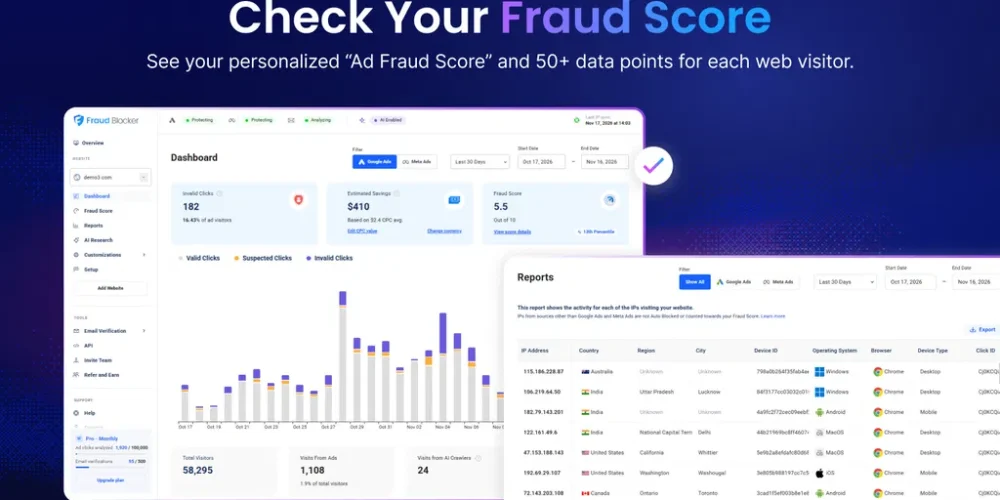
Fraud Blocker review: this AppSumo offer is aimed at advertisers who want another view of suspicious traffic and tools for excluding sources from supported campaigns. It is a Plus-exclusive deal, so eligibility and the click allowance belong near the start of the buying decision.
My verdict is to evaluate it against actual campaign and lead-quality evidence. A dashboard’s estimated savings are not automatically a verified reduction in your bill. I have not independently tested detection accuracy, exclusion behaviour or financial savings.
Check the live Fraud Blocker AppSumo offer →
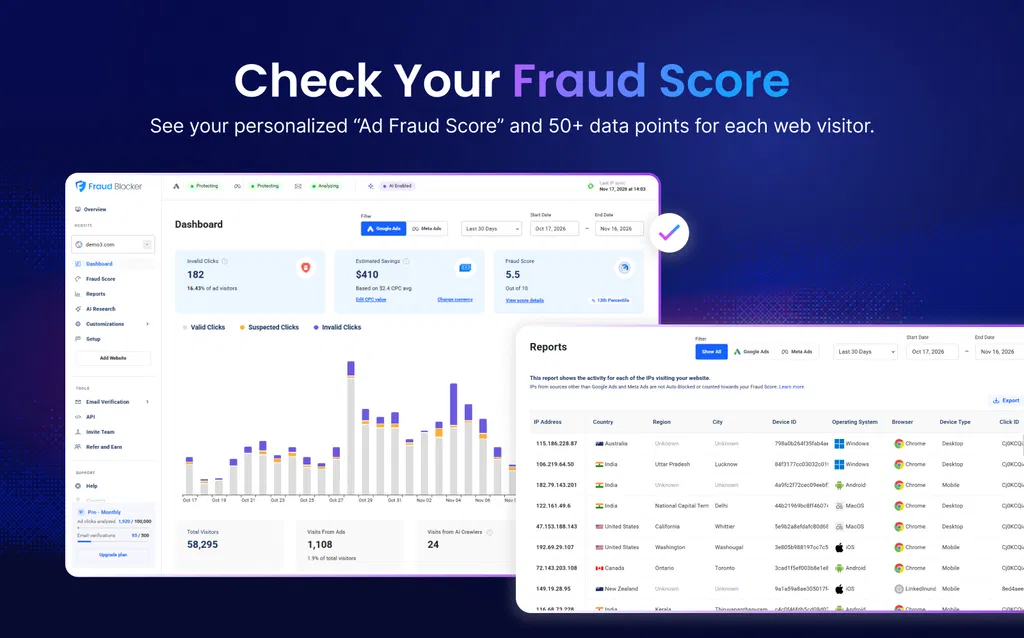
Watch the Fraud Blocker AppSumo demonstration
What is Fraud Blocker?
Fraud Blocker monitors visitor and advertising signals, assigns fraud scores and connects to supported advertising accounts. The current listing describes standard detection, higher-tier AI detection and lead-email verification. These functions address related but different problems.
A suspicious ad interaction, a fake form submission and an ordinary visitor who does not buy are not the same thing. Define the issue you are investigating before deciding which feature or report is relevant.
Fraud Blocker AppSumo pricing and eligibility
The first four tiers checked on 23 November 2026 showed these allowances. The offer was available exclusively to AppSumo Plus members.
| Tier | Price | Ad clicks / month | Domains | Email verifications / month | Team members |
|---|---|---|---|---|---|
| 1 | $80.10 | 3,000 | 1 | 0 | 3 |
| 2 | $170.10 | 10,000 | 3 | 40 | 10 |
| 3 | $323.10 | 50,000 | 50 | 150 | Unlimited |
| 4 | $458.10 | 150,000 | 50 | 400 | Unlimited |
The overview places lead-email verification at Tier 2 upwards and AI-powered detection at Tier 3 upwards. Do not assume the entry licence includes every feature highlighted in the product presentation.
Choose capacity using actual monthly clicks and sites. Advertising spend alone does not establish the tier you need because click prices differ across campaigns.
Google already filters invalid activity
Google’s invalid-click guidance explains that its systems filter detected invalid interactions from billing and may issue credits when invalid activity is identified later, where appropriate and possible.
Google’s invalid-traffic explanation also says third-party reports can flag activity Google has already filtered. That means a suspicious-traffic count should not be multiplied by an average click cost and treated as proven additional savings.
Use both sources of information to investigate the campaign. Compare dates, campaign scope and definitions before deciding that one dashboard proves the other is wrong.
Detection and exclusion are different
The official Fraud Blocker pricing FAQ identifies direct protection for Google Ads and Meta Ads and describes exporting information for other networks. Verify the specific campaign type and integration rather than assuming every detected source can be blocked automatically everywhere.
A platform logo in a reporting feature does not by itself establish equivalent exclusion support. Ask what action the connection performs, where you can verify it and what limitations apply to your campaign.
Test the installed tracking and the connected account carefully. You need evidence that the relevant visits are being recorded and that an intended exclusion appears in the advertising system, not just a status inside the monitoring tool.
False positives deserve attention
Repeated visits can have legitimate explanations. A buyer may compare options, share a connection or return through another device. A score is a signal to interpret, especially when a rule could exclude a useful prospect.
Start with the vendor’s documented configuration and inspect examples before making rules more aggressive. Review the reason for a block and whether the pattern is consistent with the problem you are trying to solve.
Keep a record of important changes. If performance shifts after a rule adjustment, the team should know what changed and when. Otherwise campaign changes, seasonality and exclusion settings can become difficult to disentangle.
Fake leads are not just a traffic problem
A form can receive low-quality submissions even when the ad platform has filtered a click. Check what information the lead contains, where it came from and whether the response process confirms genuine interest.
The email-verification allowance is small on some tiers. Forty checks per month is very different from an unlimited lead-validation service. Estimate the actual submission volume before choosing the licence for this feature.
My Formaloo review covers structured intake and workflow design. Clear form questions and a sensible follow-up process remain useful alongside any traffic-monitoring product.
Do not confuse poor fit with fraud
A real visitor can be unsuitable for the offer. Broad targeting, an unclear advert or a page that attracts the wrong expectation can produce weak enquiries without fraudulent behaviour. Review those possibilities before assigning every disappointing click to bots.
Check the path from advert to landing page to enquiry. Does the page state who the service is for, the location served and the relevant next step? My Leadpages review examines a page-building option, while my FlexiFunnels review covers a broader funnel workflow.
A traffic tool can add useful evidence, but it cannot repair an offer that is misaligned with the audience. Keep the acquisition and qualification questions separate in your analysis.
Assess savings with a credible baseline
Record the campaign’s spend, useful leads and downstream outcomes before introducing a new intervention. Note other changes, such as budgets, creatives or targeting. Without that context, a before-and-after chart can be easy to overinterpret.
Review the cost of monitoring, corrections and any lost valid traffic as part of the assessment. A high blocked count is not the objective. The objective is a healthier campaign with useful outcomes and a process the team can manage.
For an agency, explain the methodology to the client. Distinguish estimated avoided cost, platform-issued credits and actual observed changes. Those are different figures and should not be added together without checking overlap.
A practical evaluation
- Confirm Plus eligibility and the required click allowance.
- Verify support for the actual campaign types.
- Check tracking and inspect representative visitor records.
- Review exclusions and possible false positives.
- Compare useful campaign outcomes with a documented baseline.
Keep the trial narrow enough that you can understand the result. Adding several new tools and changing the campaign at the same time makes it harder to identify what helped.
Does Tier 1 include AI detection?
The checked overview places AI detection at Tier 3 upwards.
Are reported savings guaranteed?
No. Treat estimates as information to validate against campaign and billing evidence.
My Fraud Blocker verdict
Fraud Blocker could be useful when you have a specific traffic-quality problem and can evaluate the evidence. Check eligibility, feature access and campaign support, then measure practical outcomes rather than relying on a savings headline.
See Fraud Blocker pricing, limits and current availability →
Sources: current AppSumo listing and deal terms and the official sources linked in this review. Prices in USD, checked 23 November 2026; verify the live checkout total.